
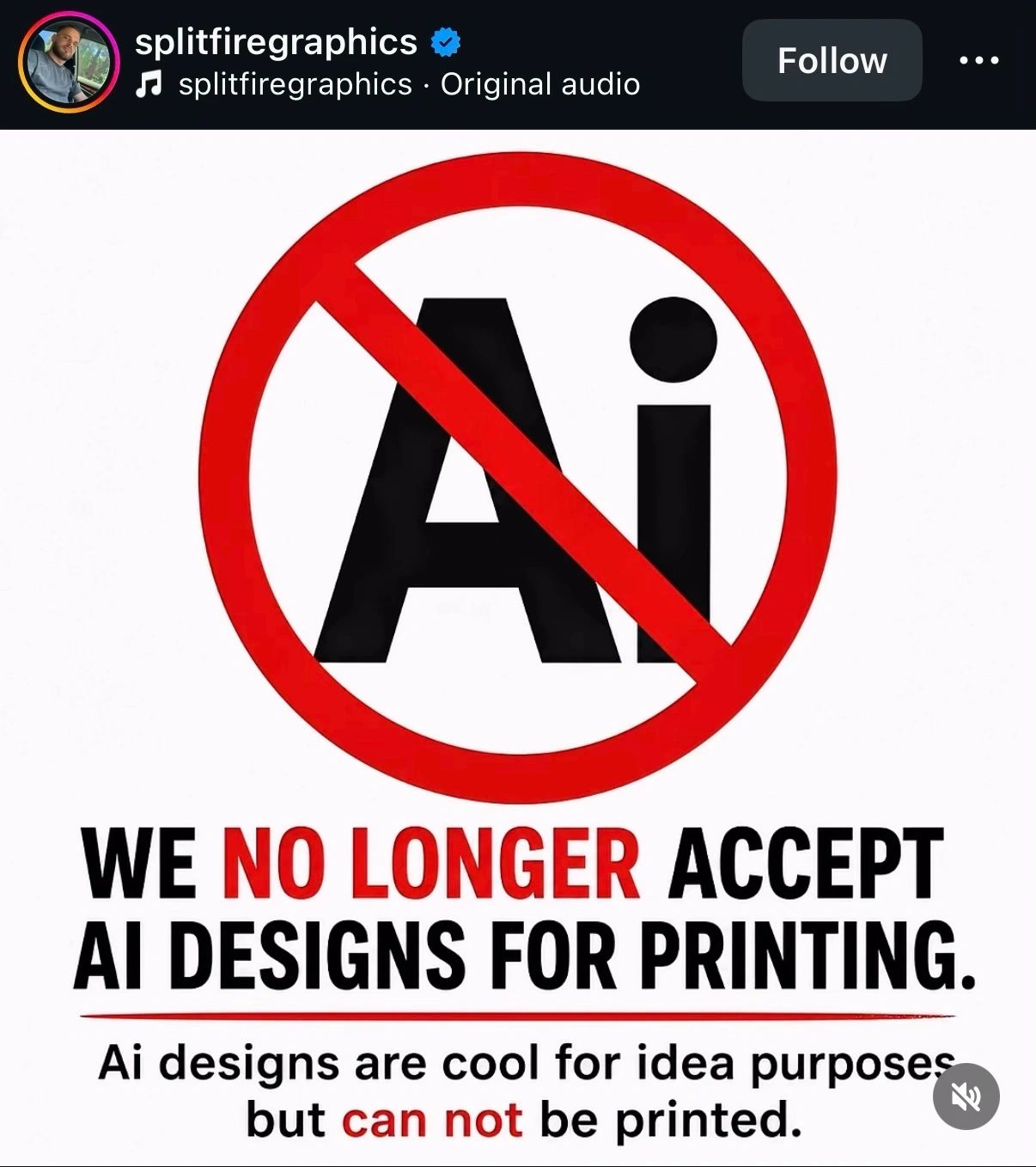
I recently came across the above post on Instagram that caught my attention.
It simply said:
"We no longer accept AI designs for printing. AI designs are cool for idea purposes but cannot be printed."
It certainly grabs your attention, but I don't think it tells the whole story.
In fact, I think it's misleading.
The reality is that AI generated artwork can be printed. I've printed it myself. What matters isn't whether AI was involved, but whether the artwork has been prepared properly for production.
As someone who has worked in the print industry for over 30 years, I've seen exactly the same debate play out before.
It's not an AI problem
When Microsoft Publisher became popular, printers complained about Publisher files.
When businesses started producing artwork in Microsoft Word, printers complained about Word files.
More recently it was Canva.
Now it's AI.
The common factor wasn't the software.
The common factor was poorly prepared artwork.
Every new design tool makes creating artwork easier, but that doesn't automatically make it suitable for commercial printing.
AI is brilliant at generating ideas
This is where I think AI deserves far more credit than it often gets.
Need a concept for a roller banner?
AI can generate several ideas in seconds.
Need a background image for an exhibition stand?
AI can produce some fantastic starting points.
Need inspiration for a brochure, leaflet or direct mail campaign?
Again, AI can help enormously.
It speeds up the creative process and removes the blank page that every designer, marketer and business owner has faced at some point.
As a business owner, I use AI almost every day.
Not because it replaces experience, but because it helps me work more efficiently. It challenges ideas, speeds up research, improves copy and often gives me a starting point that I can build upon.
Like any tool, it's only as good as the person using it.
Where things go wrong
The problems usually begin when someone assumes that because something looks good on a screen, it's automatically ready to print.
To be fair, this isn't something AI has invented. It's a challenge the print industry has faced for decades.
I've been seeing it since the days of bromides, film and repro houses. Then desktop publishing arrived and suddenly everyone had access to software capable of producing artwork that looked professional on screen. We saw the same issues with Microsoft Publisher, CorelDRAW, Microsoft Word and, more recently, Canva.
The technology changed, but the problem remained exactly the same.
Just because something looks good on a monitor doesn't mean it's suitable for commercial printing.
Every printer has received artwork that looked perfectly acceptable on screen, only to discover low resolution images, missing bleed, incorrect colours, fonts that don't embed correctly or pages set up at the wrong size.
AI hasn't created those problems. It's simply the latest tool capable of producing artwork.
The difference is that AI has made creating images and layouts faster and more accessible than ever before. That's a positive development, but it doesn't remove the need to understand the print process.
There's an old saying in computing: garbage in, garbage out.
I think the same applies to print.
Good artwork, whether it's created by a designer, in Canva or with AI, will usually produce a good printed result.
Poorly prepared artwork won't.
Typical production issues
Commercial printing is far more demanding than posting something on social media.
Common problems include:
- No bleed.
- Incorrect document size.
- RGB colours instead of CMYK.
- Images that aren't high enough resolution.
- Text too close to the trim edge.
- Missing fonts.
- Transparency issues.
- Folded leaflets that haven't been designed correctly.
- Booklets that don't work once they're imposed for print.
None of these issues are unique to AI.
They're production issues.
An experienced printer or prepress operator spots these problems almost immediately.
Someone creating artwork for the first time often doesn't know they're there until the finished job arrives.
AI doesn't understand print... yet
This is probably where I agree with many traditional printers.
Today's AI tools are incredibly clever.
They can write copy, generate images and even produce layouts.
What they don't fully understand is the manufacturing process that comes afterwards.
They don't know how a particular stock behaves on press.
They don't understand grain direction.
They don't automatically know the most suitable binding method for a brochure.
They won't question whether a small reversed font is going to remain readable once it's printed.
They don't know that moving a fold by just a few millimetres could make all the difference.
That's where experience still matters.
Experience still matters
I've spent more than three decades working in print, and one thing has become very clear.
Customers don't buy print.
They buy confidence.
Confidence that the colours will reproduce correctly.
Confidence that the brochure will fold as intended.
Confidence that the exhibition graphics will fit the stand.
Confidence that the job will arrive on time and look exactly as they expected.
That's where experience adds value.
AI can produce some incredible artwork, but it doesn't replace understanding how something is manufactured.
It doesn't know that choosing a different paper stock could improve the finish.
It won't suggest a more cost effective production method.
It doesn't automatically spot the small details that can turn an expensive print run into an expensive mistake.
Those conversations still matter.
The future isn't AI or humans
One thing I've learned over the years is that technology rarely replaces people overnight.
It changes the work people do.
Desktop publishing didn't eliminate printers.
Digital presses didn't eliminate lithography.
Online print didn't eliminate print management.
Each new technology removed some tasks, created new opportunities and changed the skills the industry needed.
AI will be no different.
It will automate repetitive tasks.
It will help people work faster.
It will generate ideas that might never have existed otherwise.
But I don't believe it replaces experience, judgement or common sense.
Those qualities are earned over time.
Final thoughts
Technology has always changed the print industry.
I've seen us move from bromides and film to computer to plate. From faxing artwork approvals to cloud based proofing. From long lithographic print runs to highly personalised digital print.
Every step has made the industry more efficient.
AI is simply the next stage of that evolution.
Will it replace some tasks?
Absolutely.
Will it replace experience?
I don't believe so.
If someone sends me AI generated artwork, I'll judge it exactly the same way I'd judge artwork created in Illustrator, Photoshop, Canva or any other design package.
Is it fit for purpose?
Can it produce the quality the customer expects?
If the answer is yes, then let's print it.
If the answer is no, let's fix it.
Because in my view, the problem has never been AI.
The problem has always been bad artwork.
And that's a very different conversation.